Things to Do in Roppongi at Night: A Visitor's Guide
Roppongi is the one Tokyo district built for people who don’t read the room in Japanese — English is everywhere, the night runs late, and you can go from a rooftop cocktail to a private karaoke suite in the space of one block. Here’s how to plan a night that fits your mood.
What Roppongi feels like after dark
Roppongi earns its reputation as Tokyo’s most international quarter honestly. Where Shibuya skews young and Shinjuku sprawls into a maze, Roppongi is compact, walkable, and used to foreign guests — menus in English, staff who switch languages without blinking, and a crowd that mixes Tokyo locals with travelers, expats, and diplomats from the nearby embassies.
The practical upshot is that you can improvise here. Two subway lines (Hibiya and Oedo) drop you at the center of it, and almost everything worth doing sits within a ten-minute walk of the Roppongi Crossing. You don’t need a fixed itinerary so much as a sense of the registers available: loud and social, quiet and intimate, or somewhere in between. A good Roppongi night usually touches two or three of them.
One honest caveat: Roppongi’s main strip has touts near the crossing, and a handful of venues bank on confusing visitors with vague pricing. The fix is simple — favor places that publish clear prices and don’t rely on someone pulling you off the street. Everything below does, and our guide to whether Roppongi is safe at night covers the rest of the guesswork.
The classic night out: bars, clubs, and live music
If you came to Roppongi for energy, it delivers. The area is dense with rooftop and hotel bars — the ones perched high in the Roppongi Hills and Midtown complexes give you the skyline with your drink — plus a deep bench of izakaya for grilled skewers and cold beer if you’d rather start with food. For late-night dancing, Roppongi’s club lounges run DJs and live acts until dawn on weekends, with bottle service and a party-floor feel.
That scene is fun, but it’s worth knowing what it costs and what it asks of you. Club lounges typically run on bottle packages and per-drink pricing that climbs quickly once the night gets going, and the volume makes real conversation hard. It’s a great choice for a big, high-energy group. It’s a poor one if what you actually want is to hear the person across from you.
Slow it down: a private lounge and karaoke suite
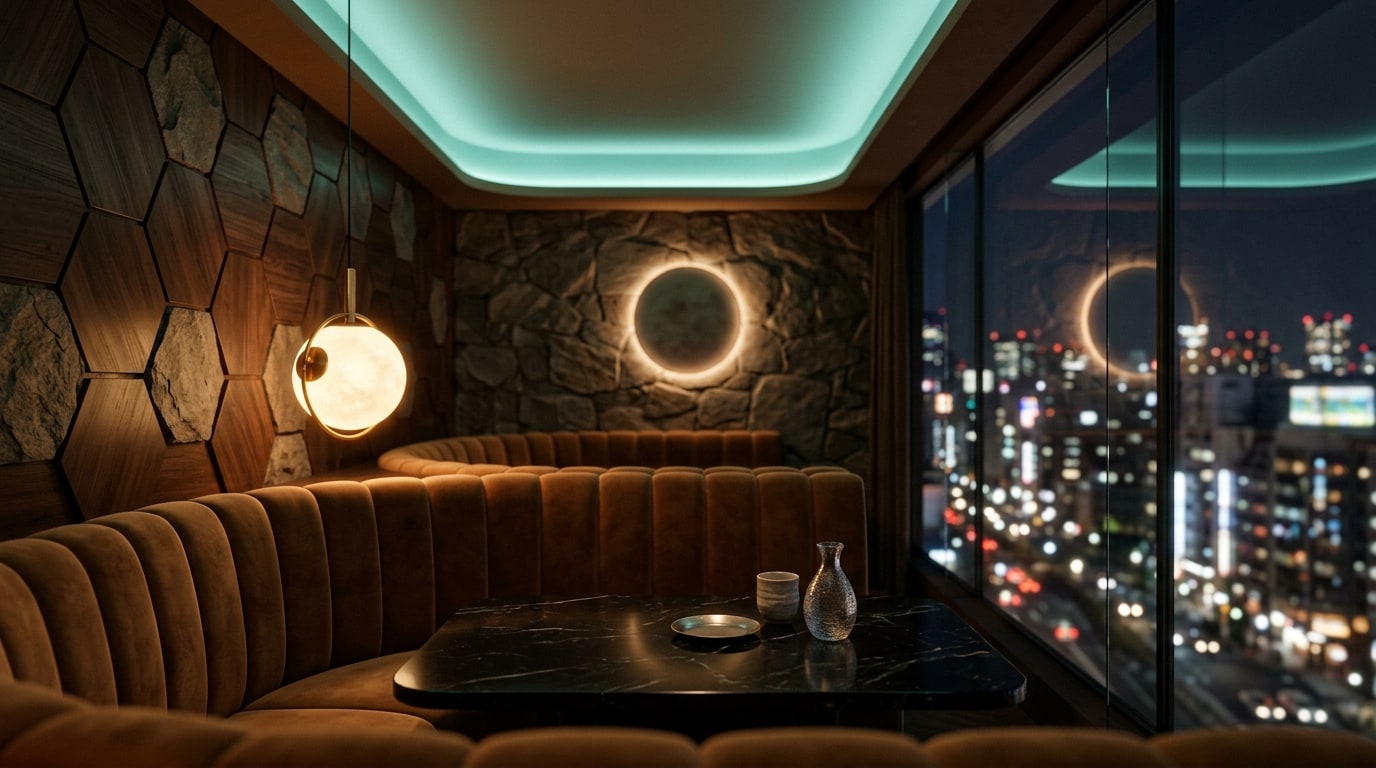
When the standing-room bars start to wear thin, Roppongi’s quieter pleasure is the private lounge — and this is where LUNE sits. We’re a casual private-suite lounge, deliberately not a kyabakura and not a members-only salon (our Roppongi nightlife glossary sorts out which venue type is which). Instead of a crowded floor, you get your own room for one to six guests, with karaoke built in, and a host who stays with your group rather than table-hopping across a packed club.
The pricing is the part visitors tend to double-check, because Tokyo nightlife has trained everyone to expect a surprise: ¥18,000 for 60 minutes, all-inclusive. That one number covers the suite, your drinks, and your host’s company — our Roppongi lounge price guide breaks it all down. The few optional extras — an extension, a bottle — are shown to you before you order. There’s no nomination fee, no per-pour meter, no “first-time” charge waiting at the end.
Our hosts are 素人 (shirōto) — amateurs, not career nightlife professionals — with 12 to 15 on rotation any given night. The appeal is exactly that they’re natural and approachable rather than performing a polished routine. And because we run a maximum of three parties per night, the room never feels rushed. You can sing, talk, or just enjoy a slow drink away from the crossing crowds. It’s the register the neon strip never advertises: comfortable, transparent, and yours to shape.
Timing your night: summer, Obon, and booking ahead
Summer is a genuinely good time to be out in Roppongi. Late July brings the big Tokyo fireworks festivals, and mid-August is Obon — the Roppongi Bon Odori dance festival sets up just a few minutes’ walk from Roppongi Station, and the whole district loosens into that warm, festival-season mood where the usual formalities relax. Counterintuitively, central Tokyo can feel a little calmer during the Obon week (August 13–16) as locals head to their hometowns, even as international visitors peak around August 15–16.
For an indoor, air-conditioned anchor to a summer evening — somewhere to land after the heat and the crowds — a private suite is hard to beat. The one thing to plan around is capacity. Because LUNE caps the night at three parties across its private suites, weekends and peak summer travel weeks fill up, and walking in on spec is a gamble. Book ahead and the night is effortless.
You’ll find us at 7-12-3 Roppongi, Power House 6F & 7F, a short walk from Roppongi Station. Reserve by calling +81-3-6434-7041 or booking online, and tell us if it’s your first time — we’ll walk you through everything in plain terms.
Frequently asked questions
What is there to do in Roppongi at night besides clubbing?
Plenty. Roppongi has rooftop and hotel bars with skyline views, izakaya for food and drinks, live-music lounges, and quieter private-suite lounges like LUNE with karaoke. You can easily combine a couple — dinner and drinks early, then a relaxed private room later — all within a short walk.
Is Roppongi good for foreign visitors who don’t speak Japanese?
Yes. Roppongi is Tokyo’s most international district, with English menus and English-capable staff at most venues. It’s the easiest area in the city to improvise a night out without Japanese. LUNE in particular is used to first-time international guests and explains everything before you sit.
How much should I budget for a night in Roppongi?
It depends on the register. Club lounges with bottle service climb fast and unpredictably. A private lounge like LUNE is a flat ¥18,000 for 60 minutes, all-inclusive, with any extras priced before you order — so you know the number before the night starts, not after.
Is Roppongi at night safe?
Broadly yes, though the main strip has touts and a few venues with vague pricing. Stick to places that publish clear prices and don’t rely on someone pulling you off the street, and you’ll be fine. Reserving ahead at a known venue removes most of the guesswork.
Do I need to book a private lounge in advance?
For LUNE, we recommend it. We run a maximum of three parties per night across private suites, so availability is limited — especially on weekends and during Tokyo’s busy summer weeks. Call +81-3-6434-7041 or book online to secure your room.
Ready to visit LUNE?
Make the calm part of your Roppongi night the easy part — reserve a private suite with one transparent price. Book your visit and tell us it’s your first time.