Private Karaoke Suites in Roppongi — LUNE Lounge
Most karaoke rooms in Tokyo have great microphones and no company. Most lounges have great company and no karaoke. LUNE is the rare overlap — a private suite in Roppongi where the karaoke system is already wired into the room, and the host pouring your highball is the one cueing up your next song.
- LUNE's three private suites each have in-room karaoke built in — not an upsell.
- The karaoke setup is fully included in the base ¥18,000 / 60-minute price — no per-song or microphone fees.
- Songbook covers English, Japanese, Mandarin, Korean; remote interface switches to English in two taps.
- This is the rare overlap of 'private karaoke' + 'lounge with hosts' — Karaoke Kan / Big Echo give you a room but no company; kyabakura gives you company but no real karaoke.
- Reservation-only with three parties per night max — the suite is genuinely yours for the session.
What a karaoke-equipped suite at LUNE actually looks like
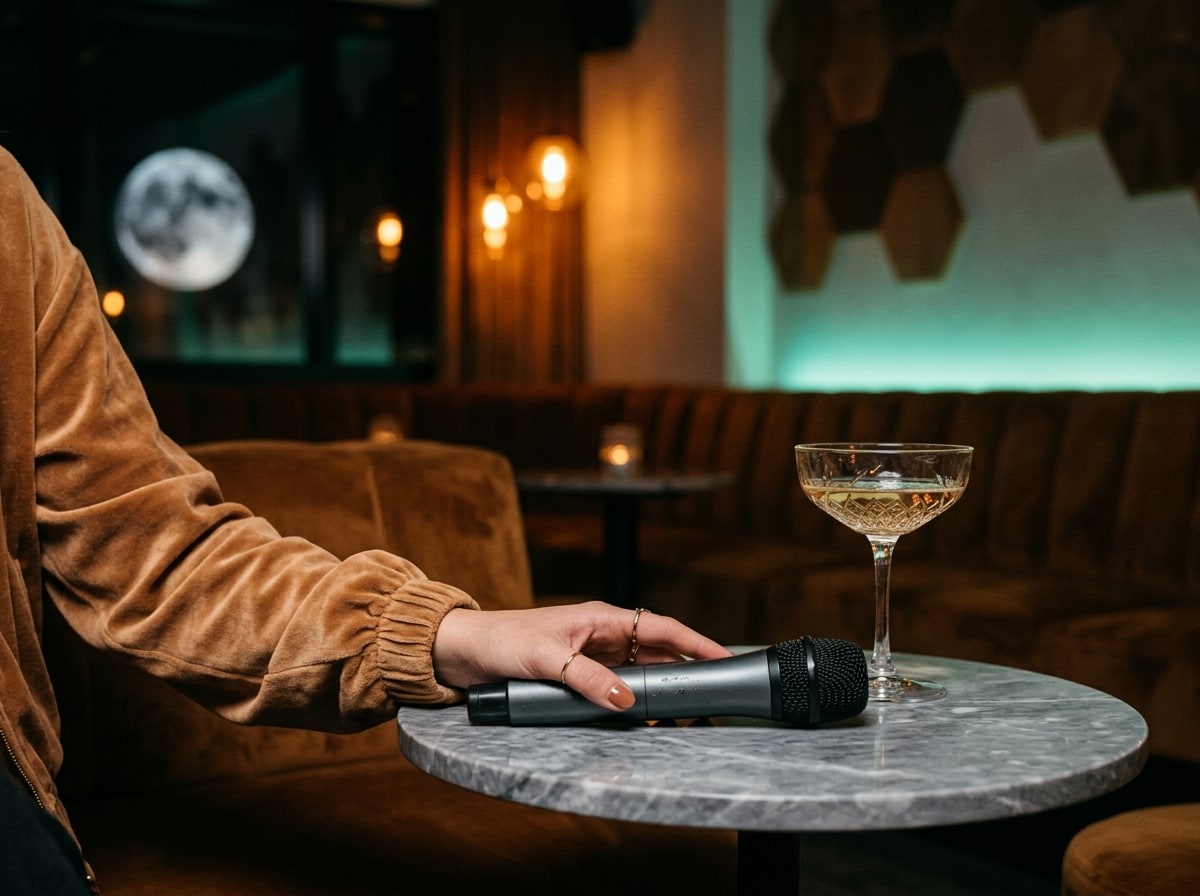
Every suite at LUNE, on the 6th and 7th floors of Power House (7-12-3 Roppongi), is built around the same idea: a small, sealed room for one to six guests, with the karaoke hardware treated as standard infrastructure rather than an upsell. You walk in to a caramel ribbed-velvet booth, a black marble table, hexagonal wood-and-stone wall paneling, and a moon-shaped pendant lamp throwing warm light onto the table top. Above you, a single accent of soft teal ceiling light. A wireless microphone and a touch-panel song selector are already on the table.
There are three suites across the two floors, and LUNE caps the venue at three parties per night — which means the suite you book is genuinely yours for the session. No shared corridors of hostesses, no cast working several rooms at once, no microphone you have to wait for. The rooms are sound-treated, so your party never hears the party in the next suite.
The karaoke catalogue is deep — a full Japanese library, an extensive English back catalogue, and meaningful selections in Mandarin and Korean. The remote interface defaults to Japanese but switches to English in two taps. If a guest doesn’t know a title in Japanese, the host knows the system well enough to find it from a hummed melody, a line of lyrics, or “the song from the new Mission: Impossible.”
Why this isn’t Karaoke Kan, and isn’t a kyabakura
Three categories of venue overlap here, and it’s worth being precise.
A karaoke box (Karaoke Kan, Big Echo, Joysound) gives you a private room, an excellent song library, and a phone to order beer and snacks. There is no host. You bring your own party, or sing alone. Pricing is per person per 30 minutes, plus drinks. The room is clean and functional; it is not designed to be atmospheric.
A kyabakura (キャバクラ) is a hostess club. Open floor, mirrored walls, bright lighting, professional hostesses in formal evening gowns rotating between tables. Karaoke is usually possible — a single shared system on the main floor that everyone uses in turn — but it isn’t the point of the venue, and the layout doesn’t really let a small group take it over. Pricing is layered: set charge, table charge, nomination charge, drink-for-the-host charge, time extensions billed in 30-minute blocks.
LUNE is a casual private lounge. The cast are 素人 (shirouto) — amateur young women in their casual clothes, no formal training and no scripted routines, rotating in a group of 12 to 15 across the calendar. They sit in your suite, pour your drinks, sing duets with you when you ask, and otherwise let your party run at your own pace. Pricing is one number: ¥18,000 per guest for the first 60 minutes, all-inclusive of the host’s company, the suite, drinks from a curated menu, and unlimited karaoke. Extensions are quoted up front, before you commit to them.
That’s the structural difference. LUNE has the room you’d want from a karaoke box, the company you’d want from a lounge, and the pricing transparency that neither category usually offers.
The song list, the language barrier, and how the room flows
A typical 60-minute session at LUNE runs about five to eight songs across the table — more if your party is sing-heavy, fewer if you’d rather talk. The host doesn’t push the microphone on you. If your group wants to spend the hour deep in conversation about Tokyo, food, or work, the host will sit with you and pour drinks. If two of you are already racing to queue the Beatles, Backstreet Boys, Jay Chou and Ayumi Hamasaki, the host will pick the next slot herself and sing something you’ll recognise.
English songs work without friction. Pop standards, current Billboard, classic rock, musical theatre — all indexed in romaji and English on the remote. Mandarin pop is well-stocked, and the songbook covers Korean hits too. If you want to try a Japanese song you’ve heard but can’t name, ask the host — most have spent enough time with the system to find it from a melody or a partial lyric.
A few practical notes. The microphone is wireless, and the songbook handles duets cleanly. Backing vocals can be toggled off if you’d rather hear yourself. The screen sits on the wall facing the booth, so the lyrics are readable from any seat. And because the suite is yours, you can pause the karaoke, go back to talking for twenty minutes, and resume — no queue, no shared room, no one else’s choice of song interrupting yours.
Pricing, booking, and what’s included
The published rate is ¥18,000 per guest for the first 60 minutes, all-inclusive. That covers the private suite, one host’s company for the full session, drinks from the standard menu (beer, highballs, wine, soft drinks, mocktails), and unlimited karaoke. There is no separate table charge, no nomination fee, no service charge added at the end. Time extensions are billed in 30-minute increments at a published rate, quoted to you in the room before you commit.
The suites hold one to six guests comfortably. LUNE is reservation-only — walk-ins are not accepted — and only three parties are booked per night, so reserving ahead matters. Weekday slots sometimes open up at short notice, but Friday and Saturday tend to fill three to seven days out, and major holiday weeks (Golden Week, Obon, Christmas, New Year) book further ahead.
To reserve, use the form at lune-roppongi.jp/en/reserve, or call +81-3-6434-7041. Either way, staff confirm in English, Japanese, Traditional Chinese or Simplified Chinese. Tell us how many guests, your preferred time, and whether anyone in your party has a song they want ready — we’ll have it cued.
Common questions
Is karaoke included in the ¥18,000 price, or billed separately?
Included. The published ¥18,000 per guest for the first 60 minutes covers the suite, the host’s company, drinks from the standard menu, and unlimited karaoke. There is no separate karaoke charge, no per-song fee, no microphone rental. Extensions are quoted at a fixed per-30-minute rate before you agree to them.
Can I book a karaoke suite for myself or a couple, without a host?
The standard LUNE experience includes a host as part of the package — it’s what makes the lounge a lounge rather than a karaoke box. If you want a pure self-serve karaoke room with no company, a Karaoke Kan or Big Echo branch in Roppongi will serve you better and cost less. If you want a private suite with company that doesn’t feel like a hostess club, LUNE is the right room.
How English-friendly is the song list and the staff?
The karaoke songbook indexes the full English-language catalogue, searchable in romaji and English; the remote switches to an English interface in two taps. Staff handle reservations and in-room service in English, Japanese, Traditional Chinese and Simplified Chinese. Most hosts speak enough English for comfortable conversation; a few are fully fluent.
Are there age, dress code or membership requirements?
Guests must be 20 or older (Japan’s legal drinking age) — bring photo ID if you look young. There is no formal dress code: smart casual works, jeans and a shirt is fine. No membership is required, and there is no first-visit surcharge. LUNE is reservation-only — walk-ins are not accepted — so book ahead via the form or by phone.