Is Roppongi Expensive? Night-Out Costs by Venue Type
Is Roppongi expensive? The honest answer is: it depends entirely on which kind of place you walk into. Roppongi has a genuinely cheap end — a standing bar where you spend ¥3,000 and leave grinning — and a genuinely premium end where one careless night can cost more than your flight home. The district doesn’t have a single price tag. It has a price range, and where you land inside that range is almost entirely a function of the venue type, not bad luck. Here is what a night out actually costs, broken down by tier, with no sugar-coating.
- Roppongi has no single price — costs swing from ¥3,000 to ¥50,000+ depending purely on venue type.
- Casual spots (izakaya, standing bars) are cheap and pay-per-item: roughly ¥3,000–6,000 per person.
- Companionship venues (snack, kyabakura, host club) stack charges and are the hardest to predict.
- A private lounge like LUNE is a single fixed number: ¥18,000 for 60 minutes, all-inclusive.
- Bill shock almost always comes from stacking charges and touts — published all-inclusive pricing fixes it.
Cost by venue tier
Roppongi nightlife splits cleanly into three pricing tiers. If you know which tier you’re sitting in, you already know roughly what the bill will be. (For the full venue taxonomy, see our guide to the types of bars in Japan.)
Casual — izakaya, tachinomi, bar (~¥3,000–6,000 per person). This is the cheap, safe, predictable end. You pay per item: a beer, a few skewers, a highball. A standing bar (tachinomi) can run even lower. There are no surprises here — the menu has prices on it, you order what you order, and the total is roughly what you’d expect in any big city. A small table charge (otōshi) of a few hundred yen is normal and not a scam.
Companionship — snack, girls bar, kyabakura, host club (highly variable, ¥10,000 to ¥50,000+). This is where prediction gets hard. A neighborhood snack simply adds a seating charge on top of your drinks — modest and usually transparent. But a kyabakura or host club stacks charges: a set charge for the first block of time, time extensions billed in chunks, a nomination (指名) fee if you keep one cast member, plus cast drinks you buy for them. Each layer is individually small; together they compound fast, which is why a single night can land anywhere from ¥10,000 to well past ¥50,000. The model is designed to scale with the evening, and that’s exactly what makes it unpredictable.
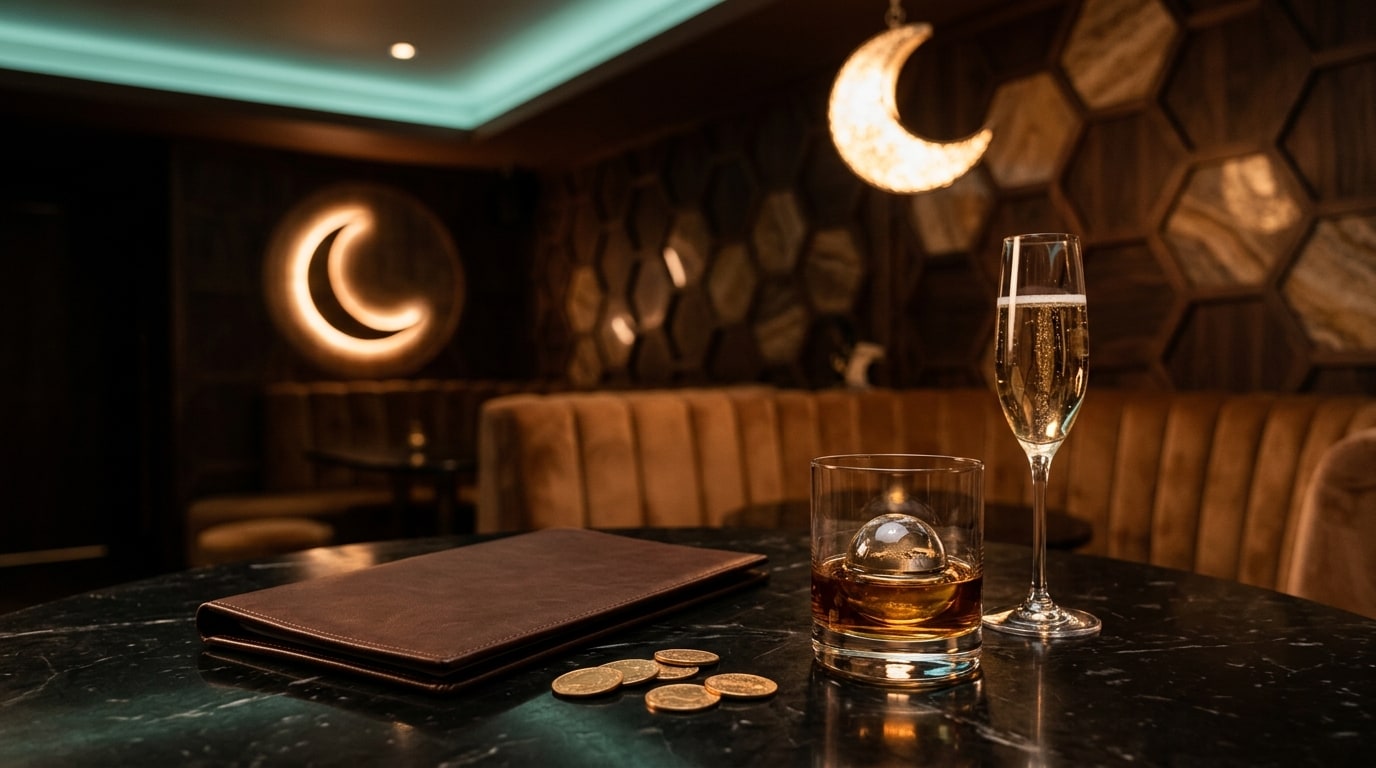
Private lounge — LUNE (fixed ¥18,000 / 60 minutes, all-inclusive). LUNE is a private lounge, not a kyabakura. The price is one number: ¥18,000 for 60 minutes, and that number already includes the private suite, free-flow house drinks, karaoke, a welcome cocktail, a rotation of 12–15 amateur (素人) hosts, tax, and service. Extensions run at the same per-hour rate. Optional extras — cast drinks, bottle service, nomination — are clearly priced if you want them, but the base experience is complete without spending a yen more. For the full breakdown, see the Roppongi lounge price guide.
A sample night, three budgets
Imagine a couple out in Roppongi for one evening, doing roughly the same thing — a few drinks and good conversation — at each tier.
Casual. Two people at an izakaya: a few rounds of drinks, a plate or two of food, the otōshi. Total: roughly ¥7,000–12,000 for the pair. You walk out knowing exactly why.
Companionship. Same couple at a kyabakura for the man and a host club for the woman, or one mixed venue: set charge each, one time extension because the night was fun, a nomination, two cast drinks. Total: realistically ¥25,000–60,000, and you’ll struggle to predict the number before the bill arrives.
Private lounge. The same couple in a LUNE suite for one hour: ¥18,000, full stop — private room, free-flow drinks, karaoke, the host rotation, all in. Want a second hour? Another ¥18,000. The number is the number before you sit down. This is also why a lounge suits a couple who wants the experience without the math.
Why some Roppongi bills shock people
The horror stories you read online are almost never about Roppongi being “expensive” in the abstract. They’re about stacking and hidden charges: a set charge you didn’t know applied, time billed in blocks you didn’t agree to, table charges per person, service fees added at the end. The other culprit is touts — the men on the street outside the station promising “¥1,000 all-you-can-drink.” That number is bait; the real bill materializes once you’re seated. Reputable venues don’t recruit off the sidewalk. We cover how to spot and avoid these traps in our guide to whether Roppongi is safe.
How to keep the bill predictable
The single best habit is to favor venues with published, all-inclusive pricing. If a place tells you one number that covers the room, the drinks, the tax, and the service, you cannot be surprised at the end of the night. If a place won’t quote you a clear price, that itself is the answer.
Two practical rules: confirm the price before you sit down, and never follow a tout. Ask what the seating or set charge is, whether time is billed in extensions, and what is and isn’t included. At a casual izakaya the menu does this work for you. At a companionship venue you have to ask explicitly. At LUNE there’s nothing to ask: the single ¥18,000 buys the suite, the free-flow drinks, the karaoke, the welcome cocktail, the host rotation, tax, and service — one number, decided before you arrive, with extras priced clearly only if you choose them.
Common questions
How much is a night out in Roppongi?
It depends entirely on the venue type. A casual izakaya or standing bar runs roughly ¥3,000–6,000 per person. A companionship venue (kyabakura, host club) can run anywhere from ¥10,000 to ¥50,000+ because charges stack. A private lounge like LUNE is a fixed ¥18,000 for 60 minutes, all-inclusive. Pick your tier and you’ve roughly picked your bill.
Why are some Roppongi bars so expensive?
Usually because charges stack rather than because any single item is outrageous: a set charge, time extensions billed in blocks, per-person table charges, nomination fees, and cast drinks all add up. Touts advertising “¥1,000 all-you-can-drink” make it worse by hiding the real cost until you’re seated. All-inclusive published pricing is the cure.
Is Roppongi more expensive than Shinjuku?
Not inherently. Both districts span the same range — cheap izakaya to premium companionship venues. Roppongi has a higher concentration of international, foreigner-friendly spots, which can read as “pricier,” but a standing bar in Roppongi costs about the same as a standing bar in Shinjuku. The venue type drives the price far more than the neighborhood does.
How much should I budget for a private lounge?
For LUNE, budget ¥18,000 per 60 minutes as your all-inclusive base — that covers the private suite, free-flow house drinks, karaoke, welcome cocktail, the host rotation, tax, and service. Add another ¥18,000 per extra hour at the same rate. If you want optional extras like cast drinks, bottle service, or a nomination, those are priced separately and clearly.
Are there cheap things to do in Roppongi at night?
Yes. Standing bars (tachinomi), izakaya, and casual bars let you have a full Roppongi night for ¥3,000–6,000 a head, paying per item with no surprises. The expensive reputation comes from the companionship tier, not from the district as a whole — the cheap options are right there next to the premium ones.
Want a night where the price is settled before you walk in? Reserve a LUNE suite at lune-roppongi.jp/en/reserve — one number, all-inclusive, English and Chinese support, and only three parties a night.