What Is a Kyabakura? Costs, Rules & What to Expect
A kyabakura (キャバクラ) is a Japanese hostess club where guests pay a set charge — plus table, nomination (指名), and drink fees — for conversation with hostesses seated at their table on an open floor. A lounge like LUNE is the casual, private-suite alternative: the same idea of company over drinks, but billed at one transparent all-inclusive price instead of a stack of charges.
From the outside they look the same — a building in Roppongi or Shinjuku, signage you can’t quite read, a closed door, an elevator. Both promise “female company over drinks.” But once you’re inside, the experience is completely different.
Here’s what actually distinguishes a lounge like LUNE from a traditional kyabakura, in the four areas that matter most. These two are only part of a much broader range of venues — if you want the bigger picture first, start with the full guide to the types of bars in Japan.
- Kyabakura (キャバクラ) is a Japanese hostess club with an open floor, formal dress, and a layered, multi-line pricing model.
- A lounge like LUNE is the casual private-suite version of the same broad category — amateur (素人) hosts, one transparent base price, no shared floor.
- Kyabakura pricing stacks set charge + table + nomination + drinks for the hostess + service — a typical visit often totals ¥30,000–¥80,000 per guest.
- LUNE's base is ¥18,000 per guest for 60 minutes, all-inclusive of house drinks, karaoke, and the 12–15 host rotation; optional extras are clearly priced.
- Choose kyabakura for the spectacle and the polished hostess performance; choose a lounge for predictable cost and a quieter, smaller-group conversation.
1. The atmosphere
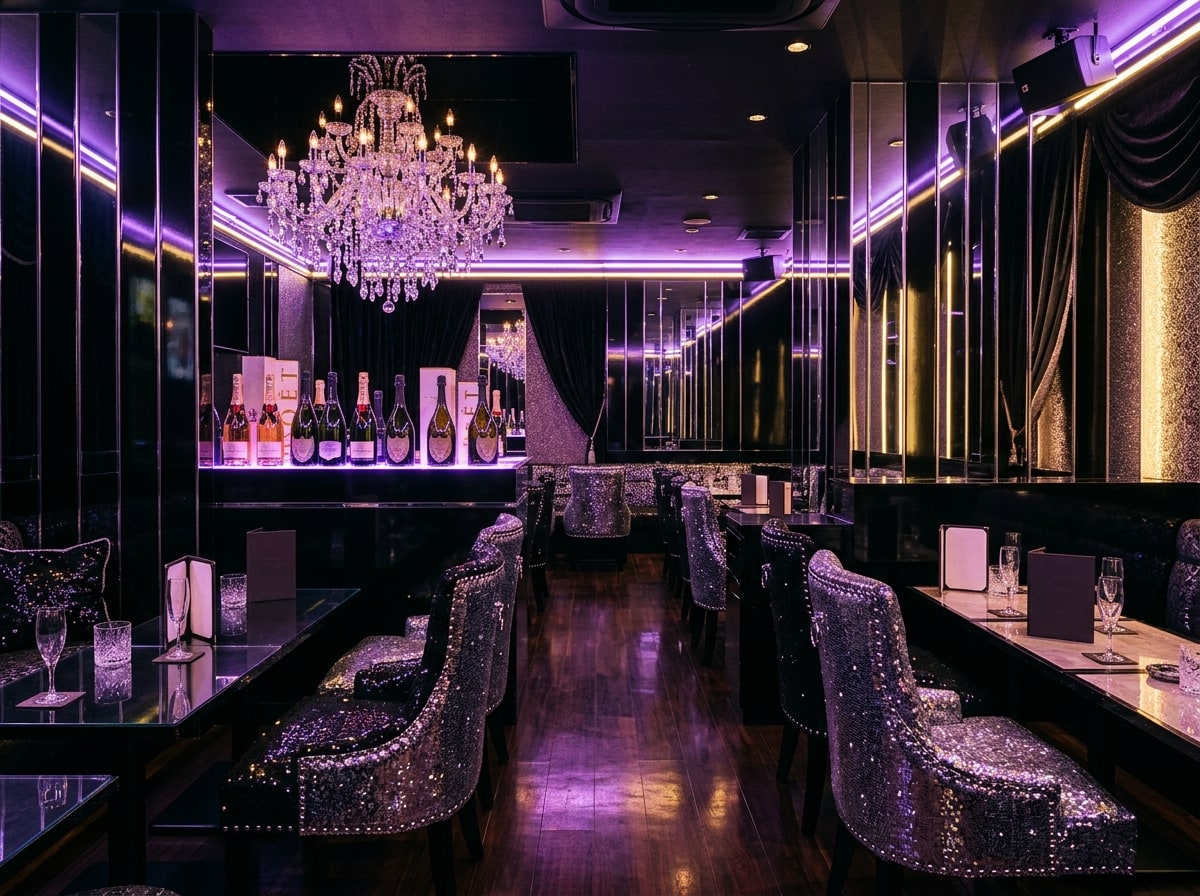
A kyabakura (キャバクラ) is a high-energy hostess club. Picture a single open floor, neon lighting, mirrored walls, sequined seats, loud J-pop, dozens of hostesses in matching glamorous evening gowns rotating between tables. The vibe is performance — the hostesses are professionals trained to perform a certain role.
A lounge like LUNE is the calm version. Small, private suites instead of an open floor. Warm lighting, leather booths, hexagonal wood paneling, wireless karaoke microphones on marble tables. The hosts are 素人 (shirouto, “amateur”) — real young women in casual clothes, no formal training, no scripted routines.
Same business model on paper. Completely different feeling in practice.
2. The pricing structure
This is where most foreigners get burned. Kyabakura pricing is famously layered:
- Set charge — the hourly base rate, often ¥5,000–¥10,000.
- Table charge — separate fee per table, often ¥3,000–¥5,000.
- Nomination fee — extra per nominated hostess.
- Drink charges — often ¥1,500–¥3,000 each, including for the hostess.
- Service charge & tax — usually 15–20% added at the end.
- VIP/extension fees — added if you stay past your initial set.
A “¥5,000 set” advertised price can become a ¥30,000 bill very quickly — and the math is intentionally hard to track in real time.
LUNE’s pricing: ¥18,000 per person for 60 minutes. That includes the private suite, unlimited house drinks, karaoke, and tax. Cast drinks and bottle service are clearly priced add-ons that you choose. There is no cover charge, no table charge, no service surcharge. The price you see is the price you pay. For a line-by-line breakdown of what’s in the base and what counts as an optional extra, see our full price guide.
3. The dress code (and the styling)
Kyabakura hostesses dress to a strict club code — sequined dresses, elaborate updos, full makeup, sometimes color-coordinated by the venue. The look is intentional: it signals “professional hostess at a formal club.”
Customers feel the pressure too. There’s an unspoken expectation to dress nicely — a shirt and trousers minimum, often a jacket. Showing up in a hoodie can feel uncomfortable.
At LUNE, the cast wears casual everyday clothing — a sweater, a simple blouse, jeans, a cardigan. Natural makeup. There is no dress code for guests either. You can come from your hotel after a long flight in whatever you’re comfortable in.
4. The cast — and what “素人” means
The biggest cultural difference: 素人 (shirouto) means “amateur” or “non-professional.” It’s a positive label in this context. It signals that the hosts are not career hostesses — they’re younger women working casually, often with day jobs or studies, who genuinely enjoy meeting new people.
At a kyabakura, the cast members are typically full-time professional hostesses with years of training in conversation, drink-pouring etiquette, and customer relationships. They’re very polished — and that polish creates a slight emotional distance.
At a lounge like LUNE, the cast is closer to “a friendly young person you meet for drinks” than to “a professional performer.” You’re more likely to have a real conversation about Tokyo, your trip, work, music, food — than to listen to a scripted “professional charm” routine. If you find one host you connect with and want her to stay for the whole hour instead of rotating, that’s called 指名 (shimei) — we cover how it works at LUNE (and how it differs from kyabakura shimei) in our shimei explainer.
So which should you go to?
Different nights, different venues. If you want the spectacle — the polished show, the sequins, the formal hostess experience — a kyabakura delivers that. If you want a quiet conversation in a private room with someone real, with prices you can predict, a lounge fits better. And if you’re still weighing more casual options for the night, our guide to choosing between an izakaya, a snack bar, or a lounge walks through where to drink based on your budget and mood.
LUNE is a lounge. Casual style, transparent pricing, small private suites, 12–15 amateur hosts on rotation each night, karaoke included (read more about how the in-suite karaoke works), by reservation only. Three suites total per night — every visit feels unhurried because we don’t cram the floor.
That’s the difference. Two business models, completely different experiences.
Lounge vs Kyabakura at a glance
| Dimension | Kyabakura | LUNE (lounge) |
|---|---|---|
| Atmosphere | Open floor, neon, mirrored walls, group hostess seating | Private sound-treated suite, warm lighting, 1–6 guests |
| Pricing | Set + table + nomination + cast drinks + service (typical ¥30k–¥80k per guest per visit) | ¥18,000 / 60 min flat, all-inclusive base; optional extras clearly listed |
| Dress code | Formal hostess gowns; guests expected smart-casual or better | Casual everyday clothing on cast; no guest dress code |
| Cast | Professional career hostesses with formal training | Amateur (素人) hosts on 15–20 min rotation; nomination optional |
Frequently asked questions
What is a kyabakura?
A kyabakura (キャバクラ) is a Japanese hostess club where guests pay a set charge — plus table, nomination (指名), and drink fees — for drinks and conversation with hostesses who sit at their table on an open floor. It is legal and licensed, distinct from a casual private lounge, and a typical visit often totals ¥30,000–¥80,000 per guest once the charges stack.
What is the difference between a Tokyo lounge and a kyabakura?
A kyabakura (キャバクラ) is a professional hostess club with an open floor, formal styling, sequined dresses, and layered pricing. A lounge like LUNE in Roppongi is the casual version — private suites instead of an open floor, 素人 (amateur) hosts in everyday clothes, warm lighting, and a single all-inclusive price.
How much does a Tokyo lounge cost compared to a kyabakura?
Kyabakura pricing is layered: a base set charge (¥5,000–¥10,000/hr), table charge, drink charges for both guest and hostess (¥1,500–¥3,000 each), nomination fees, plus a 15–20% service charge added at checkout. LUNE's pricing is a flat ¥18,000 per guest for 60 minutes, all-inclusive — private suite, unlimited house drinks, karaoke, and tax. No cover, no table charge, no surprise additions.
Is there a dress code at a Japanese lounge?
Kyabakura encourages a smart-casual or formal look for guests (shirt and trousers, often a jacket). At LUNE, there is no dress code — guests are welcome straight from a hotel or after a long flight in whatever feels comfortable. The cast also wears casual everyday clothing, not formal hostess dresses.
What does 素人 (shirouto) mean in a lounge context?
素人 (shirouto) literally means 'amateur' or 'non-professional'. In a lounge context it is a positive label — it signals that the hosts are not career hostesses, but younger women working casually, often with day jobs or studies, who genuinely enjoy meeting new people. The conversation feels more like meeting a friendly young person for drinks than watching a polished hostess performance.
Is a lounge in Roppongi foreigner-friendly?
Yes. LUNE in Roppongi, Tokyo is designed for foreign visitors: English-speaking staff are available, the menu is in English, pricing is transparent, and reservations can be made online with email confirmation within 12 hours. Several hosts speak English, and the casual private-suite format makes conversation easier than an open-floor kyabakura.
Should I go to a lounge or a kyabakura in Tokyo?
Choose a kyabakura if you want the spectacle — sequined dresses, polished hostess performance, the formal club vibe. Choose a lounge like LUNE if you want a quiet, private conversation in a small suite with hosts in casual clothes, predictable transparent pricing, and a foreigner-friendly experience. Different nights, different venues — both are valid Tokyo nightlife experiences.
Is a Japanese lounge or kyabakura a sex club?
No. Both are licensed hospitality venues where what you pay for is conversation, drinks and company at your table. There are no sexual services and the hosts are not escorts — Japan’s adult industry is a separate, differently licensed category. At LUNE a visit is conversation and karaoke in a private suite.
Are hostess clubs and lounges legal in Japan?
Yes. Both operate as licensed night-time hospitality businesses under Japan’s Entertainment Business Act (風営法), which is also why their closing hours and operating conditions are regulated.
What actually happens during a visit?
You are shown to a table or a private suite, drinks are served, and one or more hosts sit with you and talk — about Tokyo, your trip, whatever comes up. At a kyabakura the hosts rotate on an open floor and the charges stack by the hour. At LUNE, 12–15 hosts rotate every 15–20 minutes in your own private suite, karaoke included, for one all-inclusive ¥18,000 per person per 60 minutes.