Entertaining Clients in Tokyo: The Settai (接待) Guide for Foreign Businesspeople
Settai (接待) is the Japanese practice of business entertainment: hosting a client, partner, or senior counterpart at dinner and drinks, paid for by the inviting company, with the explicit goal of building the relationship rather than closing the deal at the table. If you do business in Tokyo for any length of time, you will either receive settai or be expected to give it. This guide covers how a settai evening actually works, the unwritten rules that matter, and how to choose the second venue — the part of the night that foreign hosts most often get wrong.
What settai is — and what it isn’t
Settai is not a sales pitch over dinner. In most Japanese companies, the business discussion happens in the meeting room, in daylight, on the record. Settai happens afterward, and its purpose is different: it signals that your company values the relationship enough to spend an evening — and a meaningful budget — on it. Deals are rarely discussed directly. Trust is built sideways, through food, drinks, and the willingness to be slightly less formal together.
Two practical consequences follow from this:
- The host pays. Always. There is no splitting the bill at settai. If you invited, you pay, and ideally the guests never see the bill at all — more on that below.
- The expense report matters. Settai is a budgeted, accounted-for business activity in Japan. Companies have per-head entertainment allowances, and a venue that produces a clean, predictable receipt is genuinely more useful than a slightly better one that doesn’t.
The unspoken rules
You don’t need to perform these perfectly — foreign hosts get latitude — but knowing them signals respect.
- Seating order (席次, sekiji). The most senior guest sits in the kamiza (上座), the seat furthest from the door. The most junior host sits nearest the door (shimoza, 下座), where the staff comes and goes. When in doubt, gesture your senior guest toward the seat deepest in the room and take the doorside seat yourself.
- Pouring drinks (お酌, oshaku). Nobody pours their own drink at a settai table. Watch your guests’ glasses; when one drops below half, offer to refill it, holding the bottle with two hands. They will reciprocate. Receive a pour by lifting your glass slightly with both hands.
- The first toast. Wait until everyone has a drink, let the senior person say a word or two, then kanpai together. Starting early is the most visible mistake a foreign host can make.
- When to leave. The guest of honor sets the clock. As host, you never look at your watch first. The graceful exit usually comes from the senior guest’s side (“明日も早いので…” — I have an early start tomorrow), at which point you wrap up promptly, settle the bill out of sight, and see them to their taxi.
The settai evening arc
A standard settai night has a predictable shape:
- Dinner (会食, 19:00–21:00). A restaurant — sushi, teppanyaki, kaiseki, or a good izakaya for a younger crowd. Structured, seated, the formal core of the evening.
- Second venue (二次会, nijikai, 21:00–23:00). Drinks somewhere more relaxed: a bar, a lounge, sometimes karaoke. This is where the actual relationship-building happens, because the formality of dinner loosens.
- Optional third (三次会, sanjikai). Ramen, a final bar, or — increasingly rarely — straight home. Entirely optional and driven by mood.
The nijikai is the slot most foreign hosts under-plan. Dinner is easy to book; the question your Japanese counterpart is silently asking at 21:00 is “where are we going next, and has the host thought about it?” Wandering Roppongi looking for a bar with six people in suits answers that question badly.
Why a private lounge works for the second venue
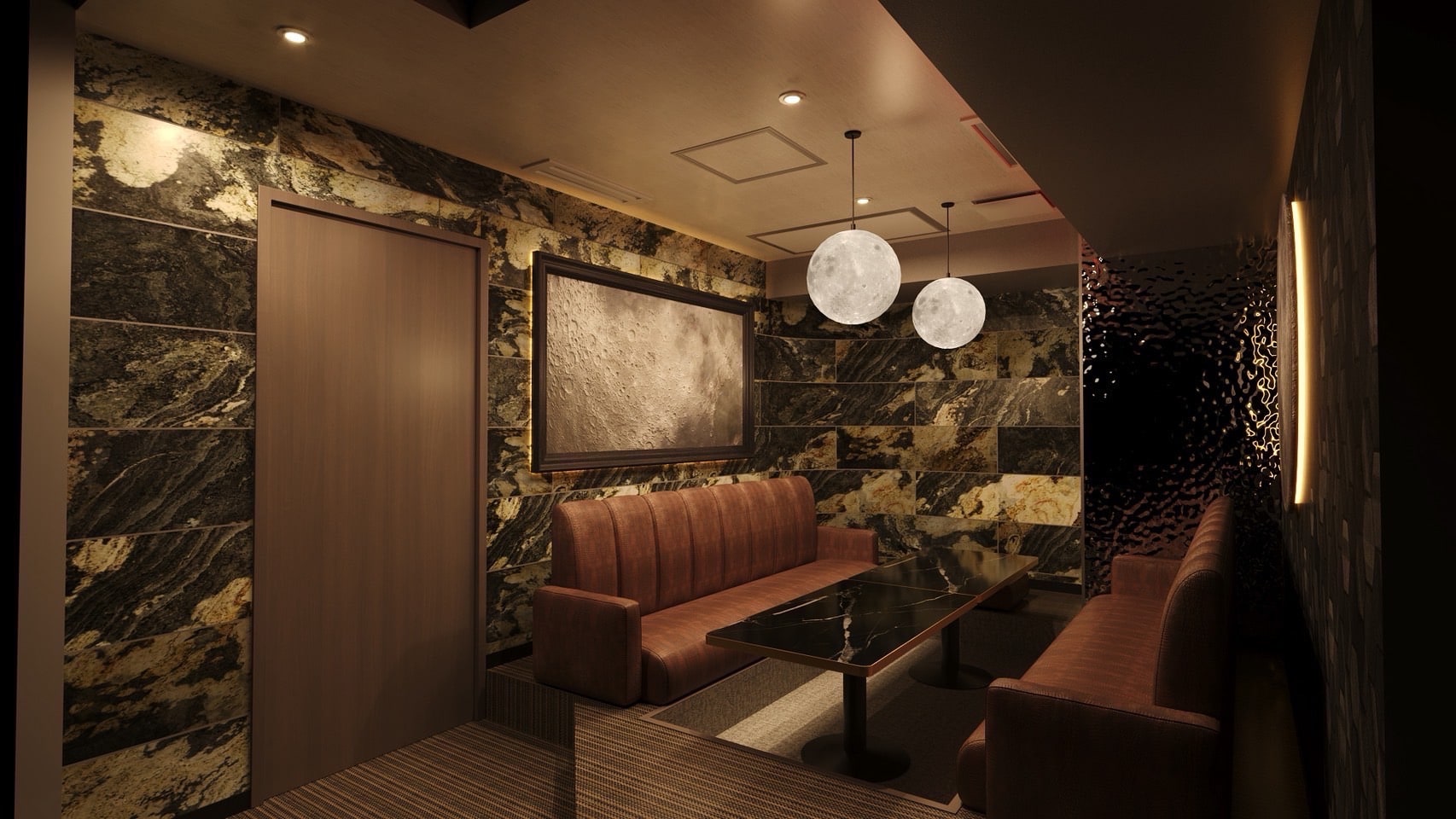
LUNE is a casual private lounge in Roppongi, and the nijikai slot is most of what we do. The reasons it works for client entertainment are practical, not atmospheric:
- Privacy. Each party gets its own suite. There is no shared floor, which means no competitor at the next table overhearing which account you’re celebrating. For lawyers, bankers, and anyone mid-negotiation, this is the feature that matters most.
- One clean number for the expense report. ¥18,000per person for 60 minutes, all-inclusive: private suite, a cast member to host the table, free-flow house drinks, karaoke, tax and service. The receipt shows one figure per head. Anyone who has tried to explain a kyabakura bill to an accounting department — nomination fees, table charges, 35% service, hostess drinks itemized line by line — will understand the value. (Our Roppongi lounge price guide breaks down how unusual flat pricing is in this category.)
- No surprise bill in front of your guests. The worst settai outcome is visible host distress at payment time. At a flat rate, you know the total before you walk in: headcount ×¥18,000 × hours, plus any extras you explicitly choose (cast drinks, premium bottles, nomination). Extensions run in 60-minute blocks at the same rate.
- Karaoke as an icebreaker. Every suite has it. You don’t have to use it — plenty of tables never touch the microphone — but when a table goes quiet across a language gap, one song from the junior staff member resets the room faster than any toast.
- Hosted conversation. Each suite is joined by cast members — 12 to 15 amateur hosts work each night, rotating through suites every 15–20 minutes. Their job is keeping conversation moving, pouring drinks, and running the karaoke queue. One honest caveat: most cast members speak limited English. Our reservation and floor staff handle English and Chinese and bridge the gap, but if your party needs deep bilingual conversation from the hosts themselves, set that expectation now. (And to be equally clear about what LUNE is not: it’s a lounge, not a kyabakura and not anything adjacent — no physical contact, strictly social. The lounge vs kyabakura post covers the distinction in detail.)
Logistics
- Location: Power House Roppongi 6F & 7F, 7-12-3 Roppongi — about one minute on foot from Roppongi Station, and a short taxi or walk from the Grand Hyatt and the Ritz-Carlton, where visiting executives usually stay. Dinner in Roppongi, Azabudai, or Nishi-Azabu connects naturally.
- Hours: 20:00–01:00, which maps cleanly onto the post-dinner slot.
- Capacity: Suites hold 1–6 guests. Only 3 suites run per night.
- Reservation-only. No walk-ins. For settai this is a feature — book before dinner, and when your guest asks “what’s next?”, the answer is a confirmed room with your name on it, not a search. Book at least a day or two ahead; three suites go quickly on weekends.
When LUNE is not the right venue
Honesty serves you better than a sales pitch here. If you are hosting a conservative senior executive — a 60-something shachō from a traditional firm, a government counterpart, anyone for whom the evening itself is ceremonial — the correct settai is a formal kaiseki dinner at a Ginza or Akasaka ryōtei, possibly with no second venue at all. That world runs on introductions and ritual, and a casual lounge with karaoke is the wrong register, however good the suite is.
LUNE suits the casual nijikai slot: post-dinner drinks with clients in their 30s–50s, mixed international teams, deal-closing celebrations, or visiting colleagues you want to show a genuinely Japanese evening without the pricing anxiety of hostess-club territory. Know which evening you’re hosting, and choose accordingly.
Frequently asked questions
What does “settai” actually mean?
接待 (settai) literally means “reception” or “entertaining.” In business Japanese it specifically refers to company-funded entertainment of clients or partners — dinner, drinks, golf — aimed at relationship-building. It is a normal, budgeted business practice in Japan, not a grey area.
Do I have to drink alcohol at a settai?
No. Declining alcohol is increasingly normal in Japanese business; the polite move is to keep a glass of something (oolong tea is the standard) so you can join every toast. At LUNE, the free-flow includes non-alcoholic options, and nobody will press you.
Can I bring a client who speaks no Japanese?
Yes — that’s a large share of our bookings. Reservation and floor staff handle English and Chinese. Cast members mostly speak limited English, so conversation across the table works best as a group activity, with staff bridging where needed. Karaoke, usefully, needs no translation.
How do I handle the bill without my guests seeing it?
Tell us at booking that you’re hosting. Because the price is flat (headcount × ¥18,000 per 60 minutes, plus any extras you’ve chosen), we can confirm the total in advance and settle payment away from the table — by card at the front desk while your guests gather their coats, or by advance arrangement.
Hosting clients in Tokyo this month? LUNE holds three suites a night, reservation-only.